
How Geminisoft Built a Visual Radio Platform with Medialooks Video SDK
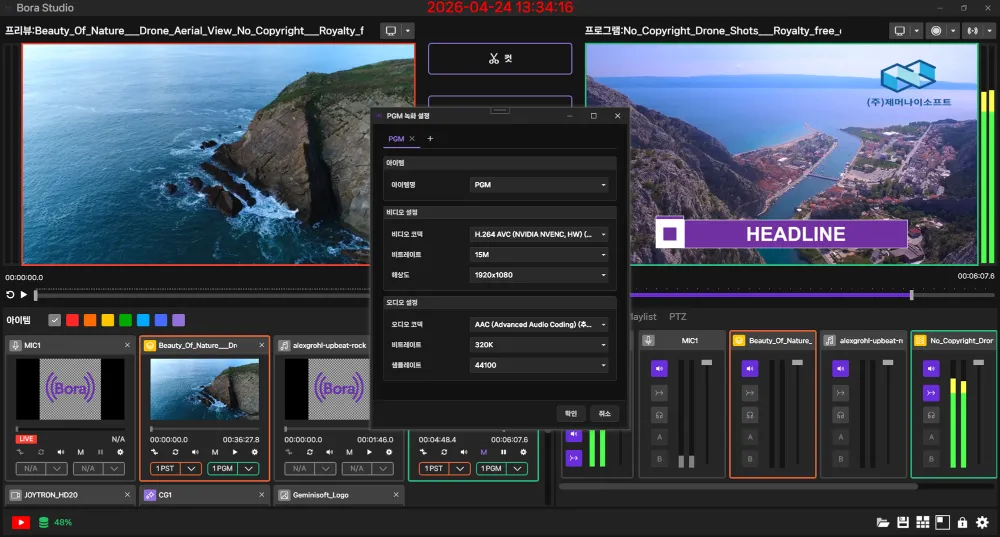
When Mr. DaeSik Choi joined Geminisoft as a developer, the project was already underway. The team was building a broadcasting application that combined traditional radio workflows with video — a format increasingly referred to in the industry as “Visual Radio.”
At its core, the product needed to handle the entire workflow, including media ingest, camera input, real-time mixing, recording, and streaming.
Rather than rebuilding an entirely new media workflow from scratch, Geminisoft combined its existing broadcasting technologies with Medialooks Video SDK-based media workflows as part of the Bora Studio architecture.
“We integrated the SDK into several major media processing workflows. It is being used across various areas including video input, camera handling, mixing, recording, and streaming.”
That decision influenced not only the product architecture itself, but also the speed and flexibility of the overall development workflow.
Building a Flexible Broadcasting Environment
Geminisoft’s product was designed to address challenges commonly faced by broadcasters and content creators.
On one side, there are highly complex professional broadcast systems that require significant expertise to operate. On the other, there are simplified tools that lack the scalability and flexibility needed for professional production environments.
The goal was to strike a balance between those two extremes.
“We wanted to provide a broadcasting environment that could be customized to the user’s workflow while still remaining accessible. The goal was to include professional-level capabilities without making the system overly complicated.”
This approach opened the door to a wide range of use cases. Broadcasters can extend traditional radio with synchronized video content, YouTubers can create professional production workflows without enterprise-level overhead, and churches or organizations can manage complete productions — including HTML-based graphics and character generation — within a single application.
A key differentiator is the integration with Geminisoft’s existing radio technology. The system can transmit radio while simultaneously receiving and processing signals for visual output, effectively bridging audio and video workflows in real time.
A New Workflow Built on a Stable Foundation
Bora Studio was not simply an extension of an existing product. It represented a newly designed workflow and product structure specifically built for Visual Radio, which required careful decisions about where engineering resources should be focused.
Geminisoft already had experience and technologies across capture, media processing, graphics, transcoding, and AI-based processing. However, some existing systems were relatively large and complex, making them difficult to directly apply to Bora Studio’s new workflow structure.
Medialooks Video SDK helped support a more flexible way of building media workflows, and the project was ultimately structured by combining Geminisoft’s existing broadcasting technologies with Medialooks SDK-based workflows.
“Because Medialooks SDK provided high-level APIs that streamlined various media processing workflows, we were able to integrate it more effectively with Geminisoft’s existing broadcasting technologies and product structure.”
This structure positively affected not only the product architecture itself, but also development speed and future scalability.
Learning Through Collaboration
As with any powerful and flexible system, there was naturally a learning curve during the early stages of integration. However, the responsiveness of the Medialooks support team played an important role during the stabilization process.
The Geminisoft team maintained ongoing communication with Medialooks engineers while troubleshooting issues and refining the product structure.
“It often felt like working with a partner. We exchanged ideas, solved problems together, and continuously improved the overall system structure.”
That collaborative process contributed directly to the stability and quality of the final product.
Improving Development Speed and Product Focus
While Geminisoft does not formally track internal metrics related to SDK adoption, the practical impact during development was clear.
Development related to the media engine accelerated, and the team was able to iterate on features and improvements more efficiently. More importantly, engineers could focus more resources on product-specific functionality and user experience improvements rather than rebuilding low-level media infrastructure themselves.
“By utilizing Medialooks SDK, we were able to reduce the burden of implementing foundational media processing workflows ourselves, which allowed us to focus more on Bora Studio’s unique functionality and user experience.”
This direction positively contributed to the evolution of Bora Studio and eventually led to a renewed SDK license as well.
AI and the Future of Visual Radio
Like many companies in the broadcasting industry, Geminisoft is actively exploring how AI technologies can be integrated into media workflows.
“AI is a very important topic for us. We are continuously thinking about how AI can be applied to Visual Radio and how it can maximize productivity in media processing.”
Because the foundation for real-time media processing is already in place, the next step is to build intelligent automation and AI-assisted workflows on top of that infrastructure.
“Professional products with strong support are always worth considering. However, to minimize early mistakes, it’s important to carefully understand the documentation and the system architecture before going too deep.”
It is a practical perspective from a team that took on a new product category, solved real technical challenges, and built a stable platform for the future.
Cuando se busca una camiseta de club, es útil comparar medidas, corte y detalles de confección antes de decidir. Dentro de esa comparación, tienda de camisetas del Atlético de Madrid mantiene la consulta centrada en la prenda indicada por el propio enlace. También conviene revisar las condiciones descritas para evitar confundir estilo, talla y comodidad.
Geminisoft’s journey also reflects a broader industry trend. As media applications become increasingly sophisticated, combining proven SDK technologies with existing in-house technologies is becoming an increasingly important strategy for building competitive products. ММС-Плюс